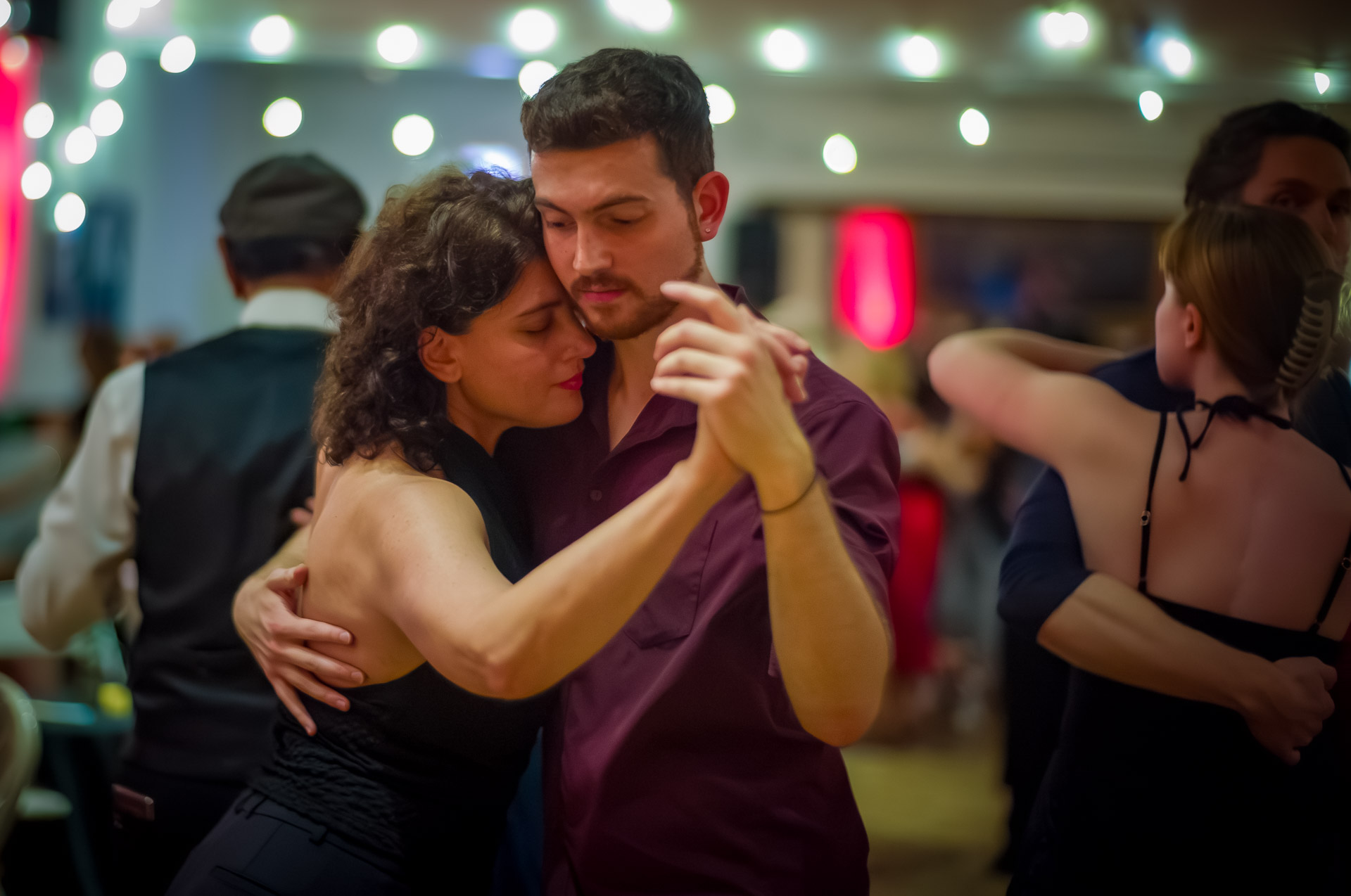
500 Frames, Real-World Tango Festival, Noctilux 50/1.0 Wide Open
I had an exciting opportunity to spend a full weekend shooting with a production Leica M EV1 (firmware 2.6.0). This is not a prototype or pre-production sample; it’s the final camera.

Since discussion online is currently driven by speculation and assumptions, here are field-tested impressions from someone who actually used the EV-1 M for demanding real-world work rather than controlled tests.
THE SHOOTING CONTEXT
• Lens: Leica Noctilux 50mm f/1.0
• Aperture: f/1.0 for the entire performance shoot
• Environment: Argentine Tango festival
• Lighting: mixed tungsten, LED, stage spots, deep shadows
• Subjects: fast, complex dance movement
• Total frames: ~500
• Modes used: 60 MP for the stage performance, 18 MP for social dancing
This is about as hard a test as you can throw at an EVF-only manual-focus M-mount camera.
1. EVF EXPERIENCE & MANUAL FOCUSING
Let me address the biggest question first:
Yes — you can confidently and consistently nail focus with a Noctilux at f/1 on moving dancers using the EV-1 M.
The hit rate was significantly higher than what I achieved with the M10 + Visoflex Type 020.
Important notes:
• Focus Peaking
There are two sensitivity levels.
• High = too “hot,” too many false positives.
• Low = excellent, clean, predictable.
It’s buried in the menu, but once set properly, peaking becomes a very reliable focusing aid. Below is the mind-blowing path to happinness.
menu > capture assistants > info profiles > info profile 1 > set to ON > focus peaking > sensitivity > low
• EVF Blackout & Refresh
The blackout/recovery behavior is very similar to SL / SL2-S, not the older Visoflex units.
This makes continuous shooting with fast primes viable.
• Real-world takeaway
The EVF is fast enough, precise enough, and predictable enough to use the Noctilux wide open exactly as it was meant to be used — but with a higher degree of confidence than with a mechanical rangefinder under these lighting and motion conditions.
2. TRI-RESOLUTION SENSOR — THREE CAMERAS IN ONE
This feature is far more important in practice than it looks on paper.
60 MP (native)
• Noticeable shutter lag (like SL3), but predictable
• Maximum detail and dynamic range
• Best for performances, controlled timing, and print output
36 MP
• Minimal lag
• Excellent balance of responsiveness and detail
• Would be a satisfying single-resolution mode on its own
18 MP
• Zero perceptible shutter lag
• Extremely responsive
• Great for reportage, social dancing, candid shooting
• Smaller files, cleaner high-ISO behavior
How I used it
• Performance: 60 MP (worth the timing adaptation)
• Social dance / candid moments: 18 MP (speed mattered more)
This tri-resolution system is not a gimmick — it’s a practical workflow tool.
3. ABOUT THE SHUTTER LAG (THE HONEST PART)
Yes, 60 MP mode has lag. Exactly like the SL3.
But — and this is the crucial point — the lag is rhythmic and consistent.
Within 10 minutes of shooting, I adapted my timing and began using a slight lead-in. Once I synced with the cadence, I had no trouble capturing dips, kicks, fast turns, and intimate transitions.

If you need immediacy, switch to 18 MP.
If you want the detail, 60 MP rewards you for learning its rhythm.
4. IMAGE QUALITY & COLOR SCIENCE
Color
Leica’s skin tones remain intact even in mixed lighting. No magenta bias, no cyan shadows, no strange hue rolls.


Noise / DR
High-ISO noise is extremely well controlled.
Shadow recovery is smooth and band-free.
Highlights roll off gracefully — especially on sequins and reflective materials.
Even at ISO12500, the noise is not offensive. However, using AI denoise function in Lightroom makes files shot at such high ISO silky-smooth yet detailed.

Microcontrast & Rendering
The Noctilux glow is preserved, but detail remains clean.
This is a modern Leica sensor pipeline, very much in line with SL3/M11.

Rolling Shutter
None observed in fast dance movement, even in 60 MP mode.
5. CROP PERFORMANCE (IMPORTANT)
Only one image from the performance set (the silver-dress mid-dip) is significantly cropped.

That frame is roughly a 30% crop of the original 60 MP file (≈40+ MP equivalent).
What impressed me:
• Eyelashes remain defined
• Sequins remain crisp
• Hair retains fine structure
• Skin transitions look natural
• No smear, aliasing, or color tearing
• The focus plane is exactly where intended, despite the dancers being in motion and the aperture at f/1
On earlier M bodies (M10/M240), achieving this level of crop flexibility at f/1 during movement was not reliably possible.
This one crop is a perfect demonstration of the real resolving power of the EV-1 M’s sensor + EVF manual focusing workflow.
6. ERGONOMICS — ONE CLEAR FLAW
As a left-eye shooter, I discovered the only real ergonomic misstep:
The diopter adjustment location does not work for left-eye dominance.

To adjust the diopter while looking through the EVF, I had to hold the camera upside down. Right-eye shooters won’t notice this. Left-eye shooters absolutely will.
Everything else feels familiar and well-executed.
7. BATTERY LIFE
I averaged around 350 shots per battery in the 60MPix mode.
Not M11-level endurance, but perfectly manageable for an evening event with one spare.
8. ABOUT THE “M MAGIC” DEBATE
I’ve already seen the predictable commentary about “losing the soul of the M.”
Here’s my response, offered politely:
A man is trying to hail a taxi. Several taxis pass without stopping. Finally, a plain car pulls over.
The man says:
“I don’t know… you don’t have checkers on the door.”
The driver replies:
“Do you want checkers — or do you want a ride?”
If you want the mechanical rangefinder experience, the M11/M11-P remain the flagships.
The M EV1 is not replacing them — it serves the situations where the rangefinder is simply the wrong tool:
• Noctilux at f/1 on moving subjects
• Close focus
• Leica R zooms & primes (with the excellent new 6-bit R adapter)
• Non-coupled lenses
• Low-light precision
• Telephoto work
• Macro
• And, frankly: aging eyes
This camera expands the M system. It does not threaten it.
CONCLUSION — WHERE EV1 M FITS
The EV-1 M is not an SL, not a Q, and not an M11 without a rangefinder. It’s something we haven’t had before:
The Precision M: The M body for the situations where the classic RF reaches its limits.
After 500 frames, including fast action at 60 MP with a Noctilux wide open, I can confidently say:
The EV-1 M deserves to stand next to the classic Ms.
Not as a replacement.
As the body that finally lets Leica M and R lenses perform at their full optical potential in demanding real-world conditions. Problems like poor rangefinder coupling calibration and focus shift on lenses like Zeiss 1.5/50 Sonnar ZM and some older Leica 1.4/35 Summilux ASPH are the things of the past.
Questions welcome! I’ll answer whatever I can.
You must be logged in to post a comment.